Prof. Dr. Rejaul Abedin (founder of GEPEA University and ThoughtWares Consulting & Multi Services International) has made notable contributions to service quality management, specifically tailoring frameworks for higher education institutions (HEIs) and specialized service industries.
Rather than viewing service quality through a generic corporate lens, his approach centers heavily on Total Quality Service Measurement (TQSM), which targets the alignment between institutional performance and consumer/user expectations.
Core Concepts of Rejaul Abedin’s TQSM Framework
Unlike traditional models (like SERVQUAL, which focus primarily on perception versus expectation gaps), Abedin’s TQSM model introduces specific concepts and proprietary tools for service measurement:
-
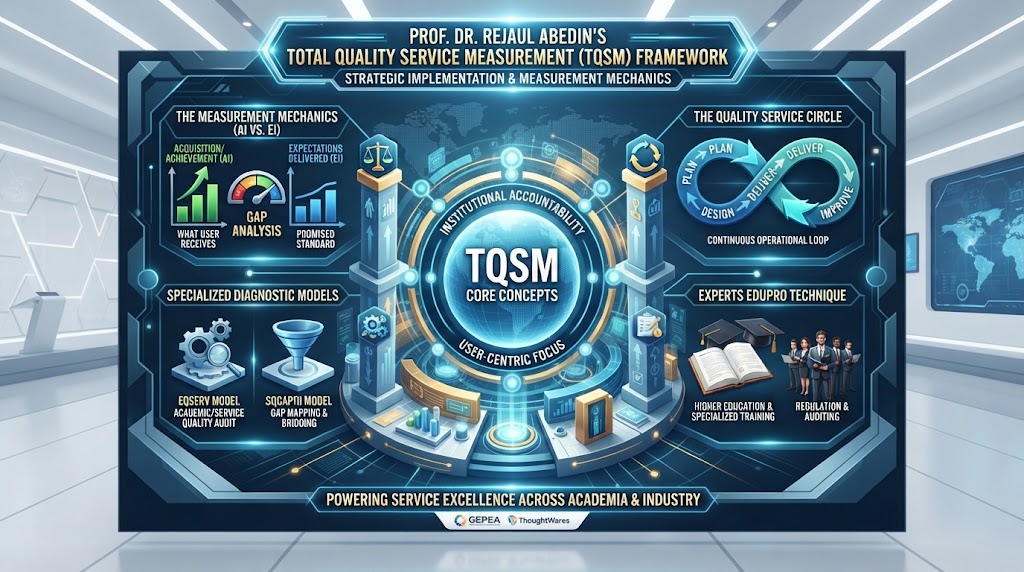
The Measurement Mechanics (AI vs. EI):
In Abedin’s TQSM framework, quality measurement is evaluated through the fundamental delta between the Institution’s/Issuer’s delivery and the Customer’s/User’s point of view, which is shaped by:
-
Acquisition/Achievement (AI): What the user actually receives or secures from the service performance.
-
Expectations Delivered (EI): The standard set or promised by the institution.
-
-
The EQServ Model & SQGAPfil Model: Specialized diagnostic frameworks developed to map, audit, and bridge service gaps in service-oriented sectors and educational institutions.
-
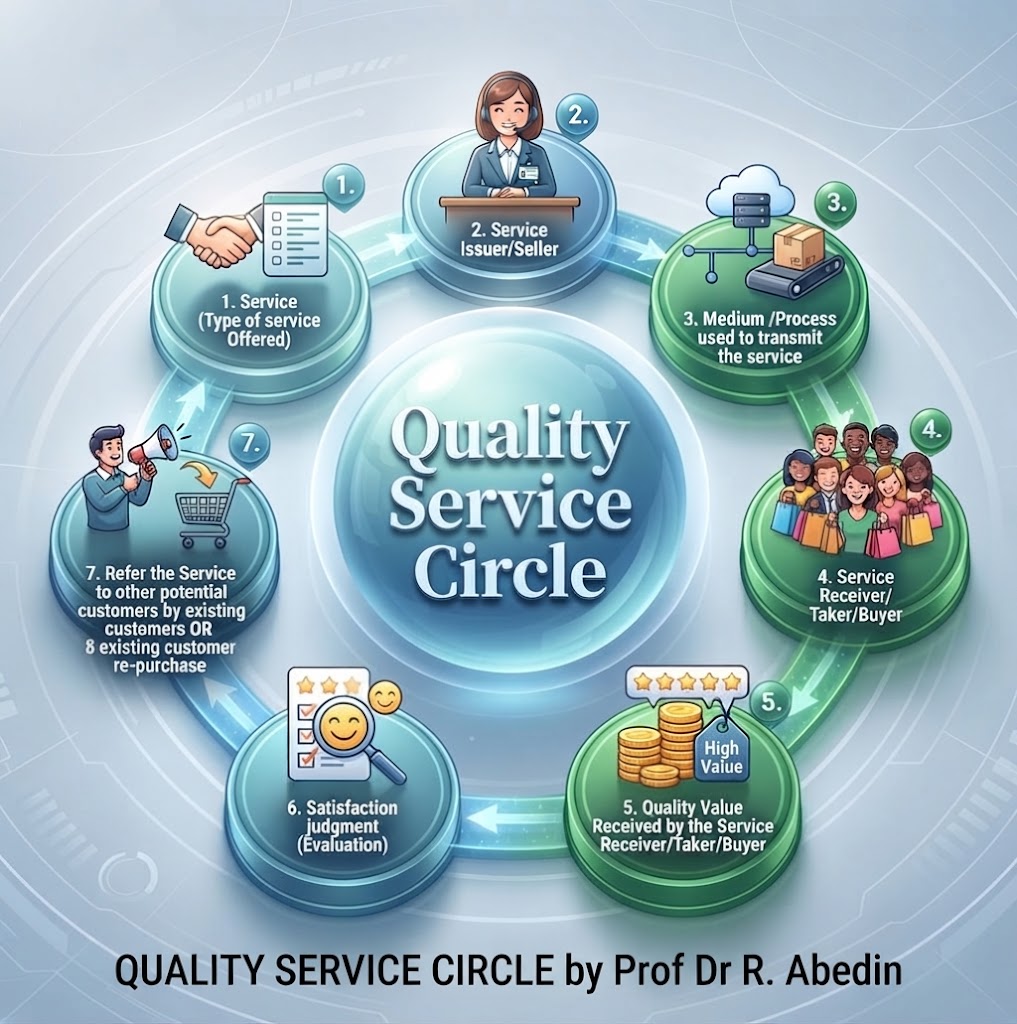
The Quality Service Circle: A continuous operational loop prioritizing the user right at the core of profit or non-profit entities.
-
Experts EduPro Technique: A tailored methodology used extensively in higher education management to audit, regulate, and improve quality service delivery within academic institutions.
Key Pillars of Abedin’s Service Quality Assessment
-
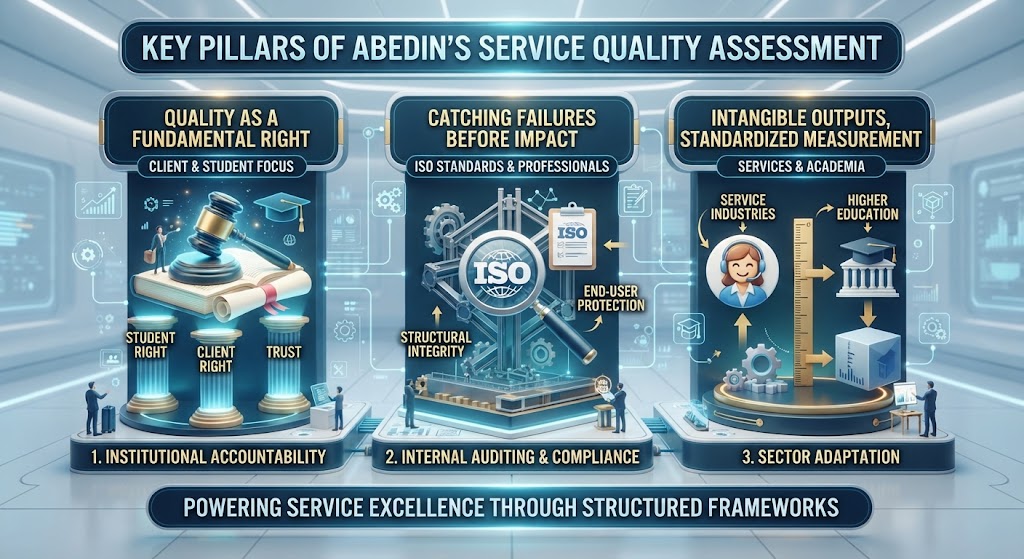
Institutional Accountability: Quality is treated as a fundamental “right” of the client or student rather than an optional corporate bonus.
-
Internal Auditing & Compliance: Drawing heavily on ISO standards, TQSM relies heavily on structured internal auditing professionals to catch structural service failures before they impact end-users.
-
Sector Adaptation: Special emphasis is placed on service industries and academia, where outputs are intangible, making standardized performance measurement critical.