AAQA Framework of Global Accreditation & Recognition: Overview and Strategic Pillars | AAQA Global Accreditation Framework
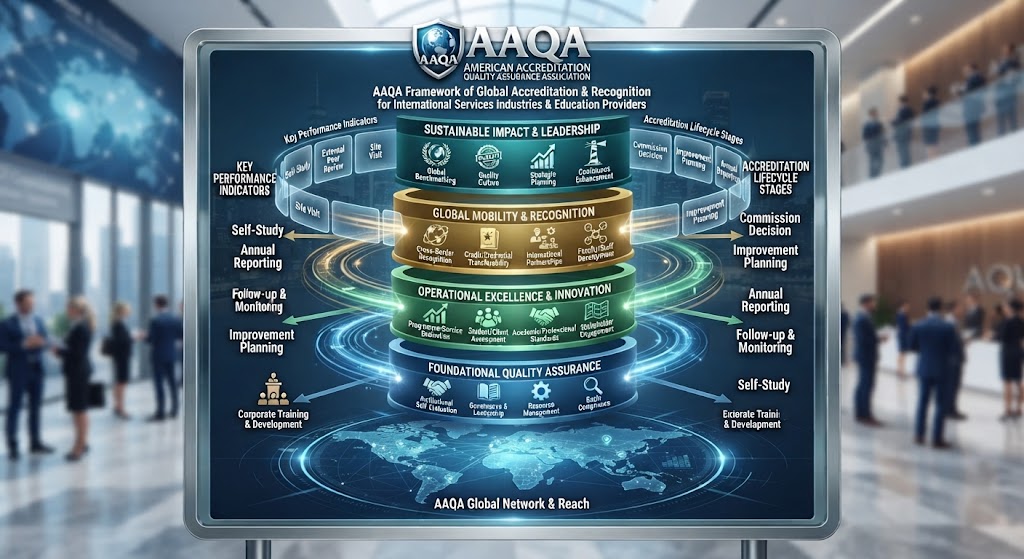
The American Accreditation Quality Assurance Association (AAQA) establishes a comprehensive global benchmark for excellence across international service industries and education providers. At its foundation, the Foundational Quality Assurance tier mandates robust institutional self-evaluations, exemplary governance and leadership structures, strategic resource management, and strict adherence to core quality components. This ensures that every accredited entity maintains a solid baseline of operational integrity and internal accountability.
Building upon this foundation, the Operational Excellence & Innovation tier drives continuous improvement through rigorous programme and service reviews, advanced student and client assessments, adherence to high academic and professional standards, and meaningful stakeholder engagement. These mechanisms ensure that providers remain responsive to evolving industry demands and educational best practices.
To foster international reach, the Global Mobility & Recognition tier facilitates cross-border recognition, seamless credential transferability, international partnerships, and the ongoing development of faculty and staff. This tier empowers institutions to operate fluidly across global frontiers, bridging diverse educational and professional ecosystems.
At the apex of the framework, Sustainable Impact & Leadership emphasizes global benchmarking, enduring quality culture, strategic planning, and continuous institutional enhancement. Supported by transparent key performance indicators and a meticulous accreditation lifecycle—ranging from self-studies and external peer reviews to site visits, commission decisions, and ongoing improvement planning—the AAQA framework guarantees that accredited providers deliver lasting value to society, the workforce, and the global education community.
AAQA Global Framework

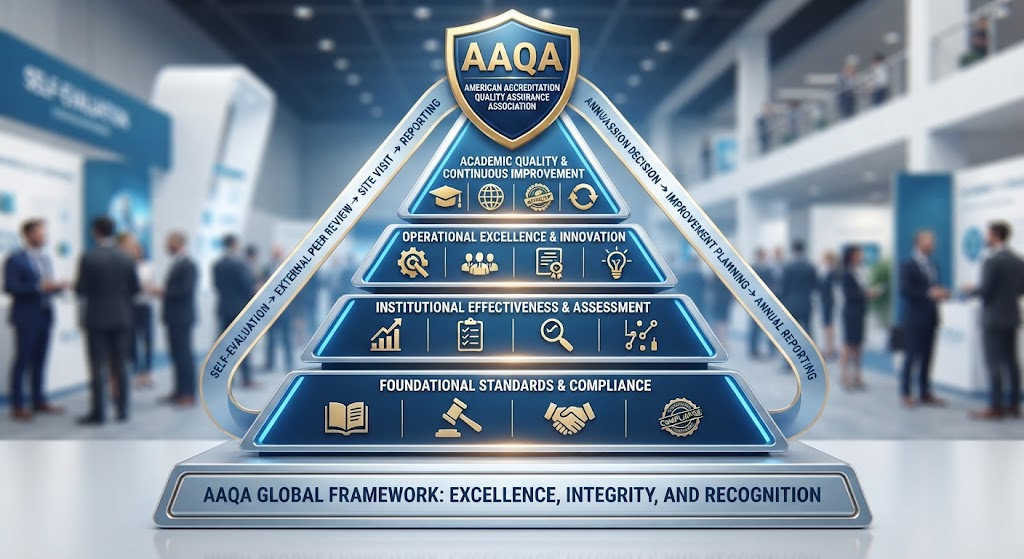
Here is a detailed breakdown of the AAQA Global Framework for Institutional Accreditation, Quality Assurance, Recognition Assessment, and Certification, based on the structural tiers and processes illustrated in the framework or in the pyramid.
Core Foundation: AAQA Global Framework
At its base, the framework is anchored in Excellence, Integrity, and Recognition, serving as the bedrock for all institutional evaluation, compliance, and quality processes.
1. Foundational Standards and Compliance
-
Core Focus: Establishes the baseline requirements, legal obligations, and fundamental operational criteria that an institution must satisfy to operate ethically and lawfully.
-
Key Components & Indicators:
-
Regulatory alignment, statutory compliance, and ethical governance (represented by the gavel and compliance stamp icons).
-
Core institutional policies, foundational documentation, and ethical standards (represented by the book icon).
-
Institutional integrity, stakeholder trust, and contractual transparency (represented by the handshake icon).
-
2. Institutional Effectiveness and Assessment
-
Core Focus: Evaluates how well an institution accomplishes its stated mission and goals through systemic measurement, data collection, and evidence-based assessment.
-
Key Components & Indicators:
-
Systematic performance tracking, metrics, and data analytics (represented by the chart icon).
-
Comprehensive programmatic and administrative evaluations (represented by the list and checklist icons).
-
In-depth internal auditing, diagnostic reviews, and accountability checks (represented by the magnifying glass icon).
-
Streamlined institutional workflows and continuous outcome mapping (represented by the process flow icon).
-
3. Operational Excellence and Innovation
-
Core Focus: Assesses the efficiency, management capability, and forward-thinking adaptability of the organization’s administrative and structural practices.
-
Key Components & Indicators:
-
Optimized process management, systemic efficiency, and resource utilization (represented by the gear icon).
-
Collaborative leadership, personnel development, and organizational culture (represented by the team icon).
-
Advanced institutional documentation, strategic frameworks, and reporting transparency (represented by the document icon).
-
Creative problem-solving, modern technological integration, and agile adaptability (represented by the lightbulb icon).
-
4. Academic Quality and Continuous Improvement
-
Core Focus: Represents the apex tier of educational delivery, focusing on high standards of teaching, learning outcomes, global standards, and iterative enhancement.
-
Key Components & Indicators:
-
Rigorous curriculum standards, faculty excellence, and student learning achievements (represented by the graduation cap icon).
-
International perspectives, cross-border educational standards, and global benchmarking (represented by the globe icon).
-
Quality validation, credential integrity, and distinction markers (represented by the badge icon).
-
A continuous feedback loop dedicated to perpetual institutional refinement and cyclical progress (represented by the iterative cycle icon).
-
5. Certification and Recognition
-
Core Focus: The culmination of the evaluation lifecycle managed by the American Accreditation Quality Assurance Association (AAQA), governing formal status awarding, public recognition, and lifecycle maintenance.
-
Key Components & Lifecycle Arcs:
-
Evaluation Phase: Driven by rigorous Self-Evaluation, External Peer Review, Site Visits, and Detailed Reporting.
-
Decision & Growth Phase: Maintained through Annual Decisions, Strategic Improvement Planning, and Annual Reporting.
-
Apex Authority: Symbolized by the AAQA shield, certifying that the institution meets global benchmarks of academic quality and institutional integrity.
-
CONTACT for more information via Email: accreditation.aaqa@gmail.com , accreditation@aaqa.us