Edu Quality Assurance

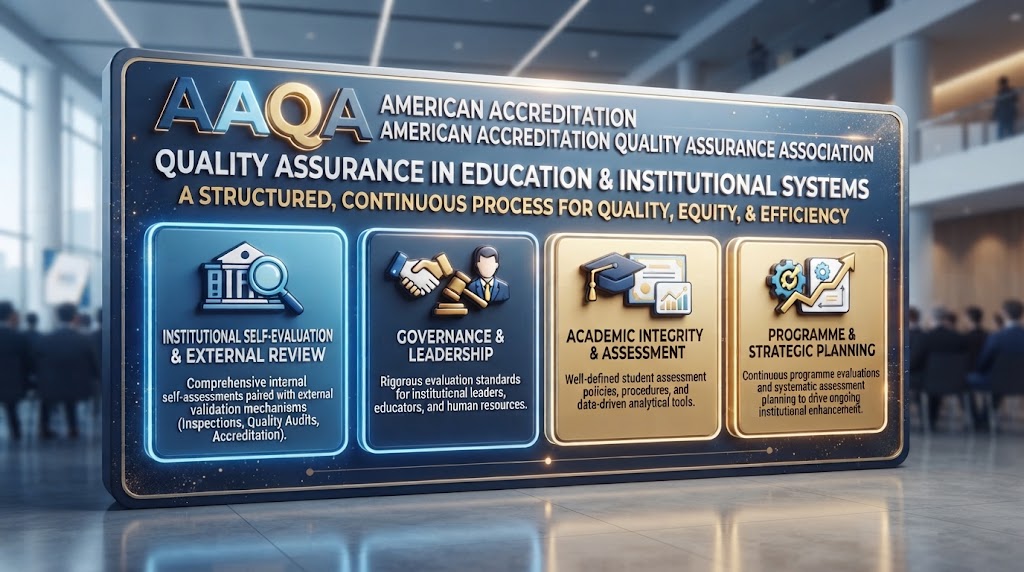
AAQA Quality Assurance in Education and institutional quality assurance systems represent a structured, continuous process dedicated to safeguarding and advancing educational quality, equity, and institutional efficiency. The framework is built upon the following core components:

  • Institutional Self-Evaluation & External Review: Comprehensive internal self-assessments paired with external validation mechanisms, including inspections, quality audits, and formal accreditation.

  • Governance & Leadership: Rigorous evaluation standards for institutional leaders, educators, and human resources.


  • Academic Integrity & Assessment: Well-defined student assessment policies, procedures, and data-driven analytical tools.

  • Programme & Strategic Planning: Continuous programme evaluations and systematic assessment planning to drive ongoing institutional enhancement.

Why Choose Online Education?

The overarching purpose of quality assurance in education is to empower students to attain the highest possible academic and personal competencies. By maintaining relevant curricula and rigorous programmes, the system equips individuals to meet the demands of working life and adapt to societal transformation.

How can we improve the quality of education?

  • Revise Educational Programs Based on Industry Changes.
  • Retrain Faculty Staff.
  • Take Advantage of Technology.
  • Make Education More Collaborative.
  • Focus on Student Retention.
  • Encourage Student Empowerment.
  • Engage with Parents or Guardians.

Ways to Improve Your University’s Quality of Education

  • Hire a Qualified Lecturer.
  • Measure the Student Outcomes and Improve.
  • Provide Opportunities to Learn.
  • Improve Teaching Methods.
  • Introduce Innovative Infrastructure and Technology.

Education can be broken down into numerous areas of functionality:

  • Curriculum and Content.
  • Teaching and learning.
  • Accreditation and assessment.
  • Research and dissemination.
  • Administration and leadership.

The Core Elements of Education Management may also review by the AAQA Auditors:

1) Academic Quality and Morality/Integrity. 2) Teaching Staff Recruitment and Their Qualification scrutiny. 3) Delivery of Programs and review the program after degree/diploma attainment by the respective students/participants. 4) Offered Student Services and offered services evaluation. and 5) In case of Distance Learning Education/Online Education Provider, Website design and performance evaluation.

The 7 Teaching Principles:

The AAQA also conforms about The 7 teaching principles, in 1987, Arthur W. Chickering and Zelda F. Gamson answered this question when they wrote “Seven Principles for Good Practice in Undergraduate Education.” They defined what good education means at the undergraduate level. The seven principles are based upon research on good teaching and learning in the college setting. 

The 7 Teaching Principles: The first principle encourages contact between students and faculty. The second principle develops reciprocity and cooperation among students. The third principle promotes active learning techniques. The fourth principle requires the instructor to provide prompt feedback to students. The fifth principle emphasizes time on task. The sixth principle requires the instructor to communicate high expectations to students. The seventh and final principle requires the instructor to respect the diverse talents and ways of learning that the student body has to offer.  

What is International Education? International education is a dynamic concept encompassing the mobility of individuals, intellect, and ideas across political and cultural boundaries. Propelled by globalization, which increasingly minimizes geographical constraints on economic, social, and cultural frameworks, it spans a diverse spectrum of learning experiences. This includes both formal education and informal modalities—such as professional training, exchange programmes, and cross-cultural communication. Furthermore, it entails a strategic reorientation of academic perspectives, fostering “worldmindedness” as a core institutional objective to ensure an internationally aligned academic focus.

Understanding International Education International education represents a multi-dimensional framework defined by several core characteristics:

  • Cross-Border Mobility: The active exchange and movement of people, minds, and ideas across political and cultural frontiers.

  • Global Connectivity: Driven by globalization, it transcends traditional geographical barriers to shape economic, social, and cultural landscapes.

  • Diverse Learning Pathways: Encompasses a comprehensive range of educational experiences, from traditional formal schooling to informal training, student exchanges, and intercultural dialogue.

  • Academic Global-Mindedness: Involves shifting academic outlooks to cultivate “worldmindedness,” embedding an international perspective directly into the institutional identity and curriculum.


Perspectives on International Education and Educational Management

Dimensions of International Education

International education serves as a catalyst for cultivating “international-mindedness” and fostering a heightened global perspective and awareness. From an ideological standpoint, it places significant emphasis on moral development by actively nurturing positive attitudes toward peace, international understanding, and responsible world citizenship.

Overall, international education encompasses the following core pillars:

  • Fostering Global Awareness: Promoting international understanding, international-mindedness, and comprehensive global awareness.

  • Global Engagement: Encouraging active participation in global engagement and the cultivation of world citizenship.

  • Intercultural Respect: Increasing intercultural understanding and deep respect for diversity.

  • Peace and Tolerance: Cultivating tolerance and a steadfast commitment to peace.

Defining Educational Management

Educational management involves the systematic organization and coordination of human resources, material assets, and strategic ideas within an educational institution. This multidimensional scope engages diverse stakeholders, including teaching and non-teaching staff, students, parents, community representatives, and departmental officials. Beyond resource coordination, educational management prioritizes human resource management—encompassing the recruitment, hiring, and professional development of institutional personnel—by applying advanced organizational and managerial best practices.

The Scope of Educational Management

The scope of educational management plays a vital role in determining how effectively an educational programme achieves its strategic goals while fostering the professional growth of its community. Its purview spans all operational dimensions of educational institutions, ranging from the optimization of campus facilities to meticulous record-keeping, as well as the coordination of specialized initiatives such as school-based health and physical education. Structurally, this overarching function is frequently divided into two primary sub-sectors: educational administration and human resource management.


The scope of educational management is as broad as the field itself. It encompasses all activities designed to achieve an educational goal, from the school level to the college or university level. The scope of educational management encompasses anything that is done to enhance the quality of education, including the supply of resources and the cultural and educational needs of a specific group. However, educational management’s scope is much broader than its definition’s boundaries.

For instance, educational
administration concerns itself with the development of human personality. As
such, it is particularly delicate in nature, requiring careful consideration of
the total life of a student. It means that educational administration requires
the participation of individuals from all aspects of life to be effective. 

Key Elements and Scope of Educational Administration

Despite its broad scope, educational administration comprises several foundational elements. First, it requires the identification of critical institutional data stored securely within school and district management systems. This data is subsequently analyzed to generate measurable performance indicators that reflect the overall quality of the educational institution.

Furthermore, educational management addresses vital financial and operational matters—ranging from budgeting and personnel management to student services and facility oversight. It encompasses the management of institutional infrastructure, including physical facilities, equipment, and administrative resources. Although comprehensive, this academic discipline is continuously evolving.

The Eight Core Components of Educational Management

The American Accreditation Quality Assurance Association (AAQA) strictly monitors and evaluates eight core components throughout its accreditation tenure and unique evaluation processes. These components include:

  1. Educational Planning

  2. Educational Administration

  3. Educational Organisation

  4. Educational Direction

  5. Educational Co-ordination

  6. Educational Supervision

  7. Educational Controlling

  8. Educational Evaluation