The American Accreditation Quality Assurance Association (AAQA) employs a sophisticated, multi-tiered architecture of quality assurance. This comprehensive model integrates three signature paradigms—The QUA-SEAL Framework, The QuaA-PEACS Methodology, and The 8-Pillar GEM Framework (Global Educational Management)—to establish a globally recognized benchmark for educational institutions and service industries.
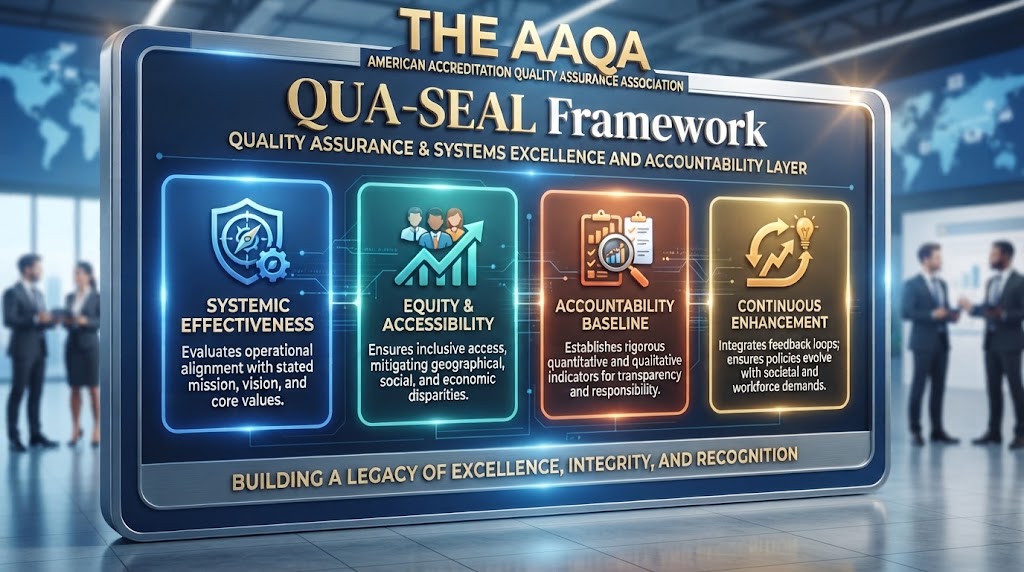
1. The QUA-SEAL Framework (Quality Assurance & Systems Excellence and Accountability Layer)
The QUA-SEAL Framework serves as the structural foundation for baseline institutional integrity and accountability. It ensures that every accredited provider meets rigorous international thresholds before achieving full recognition.
-
Systemic Effectiveness: Evaluates how effectively an institution aligns its operational frameworks with its stated mission, vision, and core values.
-
Equity & Accessibility: Mandates that educational provisions and services maintain inclusive access, mitigating geographical, social, and economic disparities.
-
Accountability Baseline: Establishes rigorous quantitative and qualitative indicators to verify that internal management systems operate transparently and responsibly.
-
Continuous Enhancement: Integrates feedback loops into daily operations to ensure that institutional policies evolve alongside societal and workforce demands.
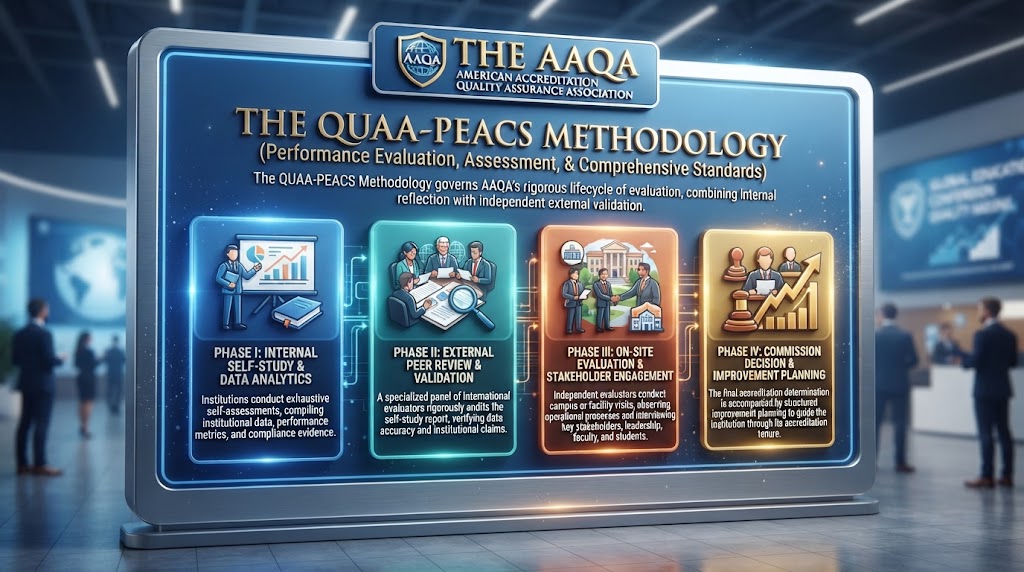
2. The QUAA-PEACS Methodology (Performance Evaluation, Assessment, & Comprehensive Standards)
The QUAA-PEACS Methodology governs AAQA’s rigorous lifecycle of evaluation, combining internal reflection with independent external validation.
-
Phase I: Internal Self-Study & Data Analytics: Institutions conduct exhaustive self-assessments, compiling institutional data, performance metrics, and compliance evidence.
-
Phase II: External Peer Review & Validation: A specialized panel of international evaluators rigorously audits the self-study report, verifying data accuracy and institutional claims.
-
Phase III: On-Site Evaluation & Stakeholder Engagement: Independent evaluators conduct campus or facility visits or virtual site visits, observing operational processes and interviewing key stakeholders, leadership, faculty, and students.
-
Phase IV: Commission Decision & Improvement Planning: The final accreditation determination is accompanied by structured improvement planning to guide the institution through its accreditation tenure.
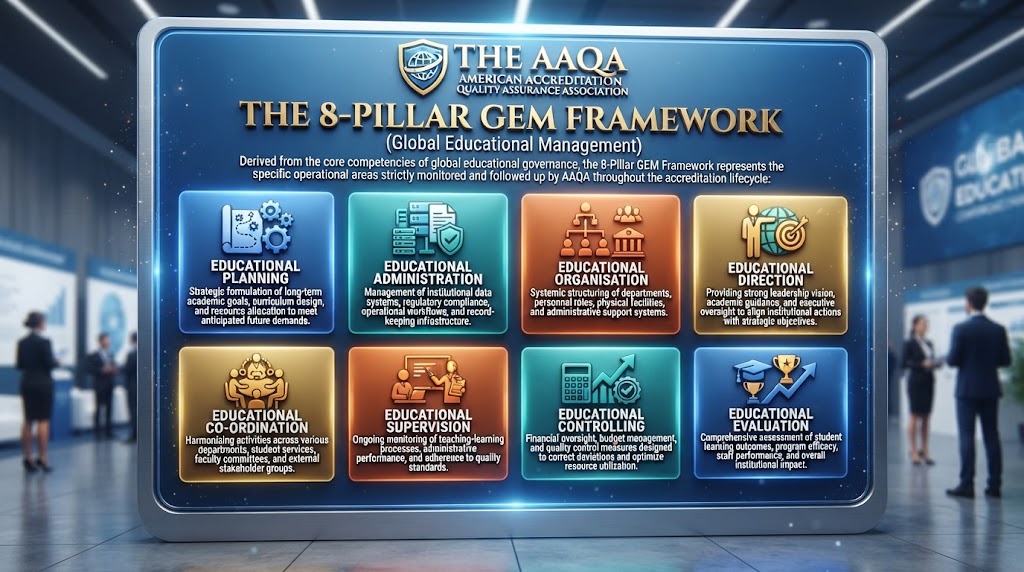
3. The 8-Pillar GEM Framework (Global Educational Management)
Derived from the core competencies of global educational governance, the 8-Pillar GEM Framework represents the specific operational areas strictly monitored and followed up by AAQA throughout the accreditation lifecycle:
-
Educational Planning: Strategic formulation of long-term academic goals, curriculum design, and resource allocation to meet anticipated future demands.
-
Educational Administration: Management of institutional data systems, regulatory compliance, operational workflows, and record-keeping infrastructure.
-
Educational Organisation: Systematic structuring of departments, personnel roles, physical facilities, and administrative support systems.
-
Educational Direction: Providing strong leadership vision, academic guidance, and executive oversight to align institutional actions with strategic objectives.
-
Educational Co-ordination: Harmonizing activities across various departments, student services, faculty committees, and external stakeholder groups.
-
Educational Supervision: Ongoing monitoring of teaching-learning processes, administrative performance, and adherence to quality standards.
-
Educational Controlling: Financial oversight, budget management, and quality control measures designed to correct deviations and optimize resource utilization.
-
Educational Evaluation: Comprehensive assessment of student learning outcomes, program efficacy, staff performance, and overall institutional impact.